Cultivated Courage
Drake lied (kind of)
The Original Bottom
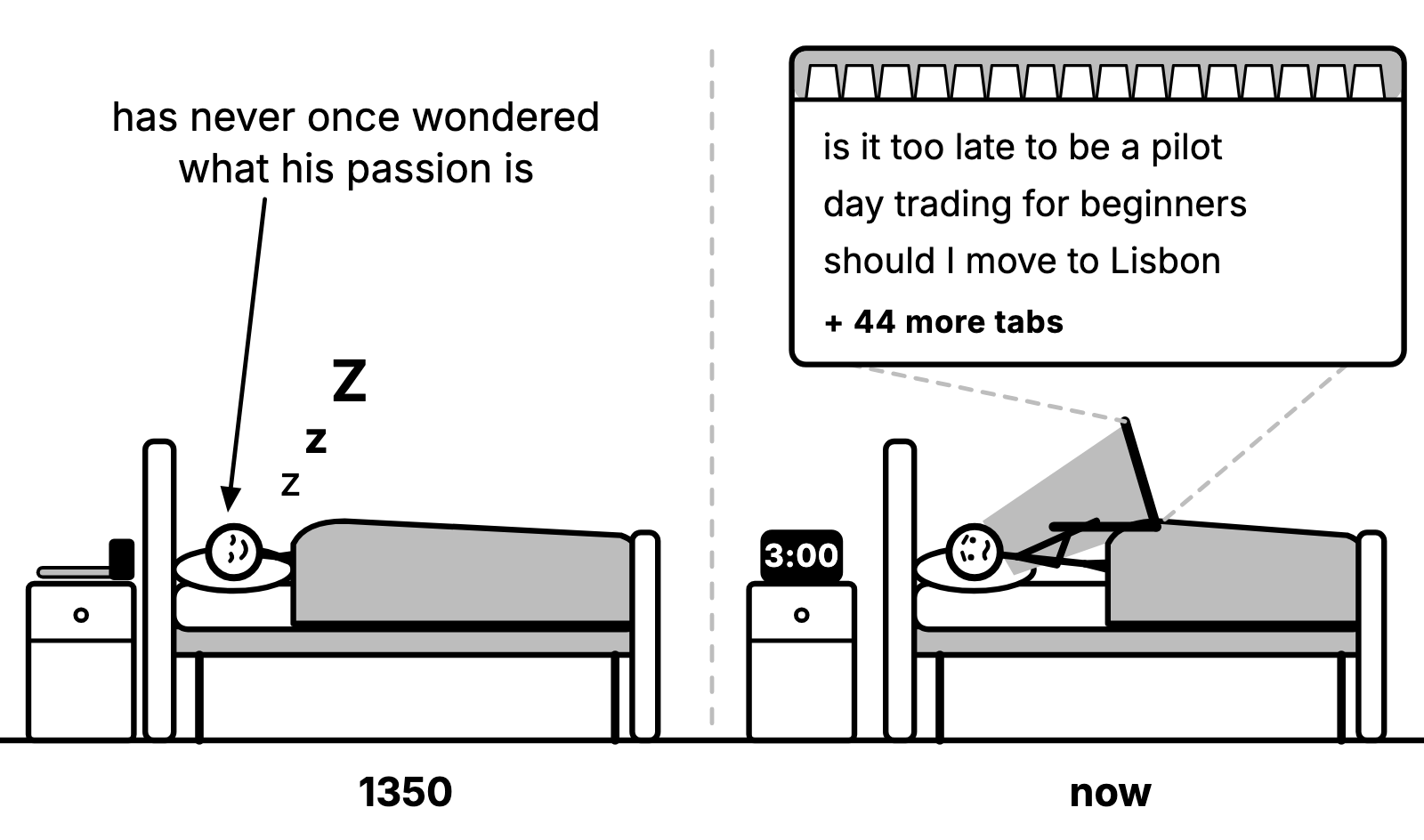
Meet John. He’s a blacksmith’s son in 1350. We’re calling him John, because chances are high he was one (in 1350 you could throw a horseshoe in any direction and hit someone with the name).
By age six, John knows his whole life.
He’ll work the anvil his father works.
He’ll marry a girl from the next village, probably one his mother has already picked out.
He’ll sit in the same pew every Sunday, pay the lord the same dues, and get buried next to his grandfather, who was also a blacksmith.
Nobody ever asked John what he wanted to be when he grew up, because the answer was standing three feet away, sweating.
His life was hard in ways ours isn’t.
There was no penicillin. Plague was still a thing, and the dental plan was a guy with pliers.
But John never lay awake at 3am wondering if he should have gotten into crypto or become a pilot.
He had no LinkedIn.
There was no anxiety about his five-year plan, because his five-year plan was the same as his fifty-year plan: don’t die.
John and his medieval homies never had a midlife crisis.
Plenty of them made it to midlife. They just didn’t have the word for it.
The phrase didn’t even exist until 1965, when a psychoanalyst named Elliott Jaques coined it.
It turns out a midlife crisis requires a few things, the main one being options (the young girlfriend with the fake titties wouldn’t even be possible for a few hundred years still).
The Deal We Made
The psychologist Erich Fromm wrote about this trade in 1941, in a book called Escape from Freedom.
In the old world, he said, everybody was “chained to his role in the social order.”
Your job was who you were, the way a hammer is a hammer.
A person was “a peasant, an artisan, a knight.”
That was roughly the whole character menu, and you didn’t get to pick.
If three characters doesn’t seem like much, you’re right.
It was a prison.
Fromm’s twist is that it was also its own form of a security blanket.
A fixed place, he wrote, “gave a feeling of security and of belonging.”
You never had to wonder who you were supposed to be. The village had already decided for you. At your christening.
(Fromm wasn’t romanticizing it, and neither am I. If you’re tempted to go back, please reread the plague bit.)
The past wasn’t a perfect caste, either. People moved, married up, ran off to cities.
But it was a lot more fixed than ours:
- Around 1300, about half of rural England was legally unfree. You inherited your status the way you inherited your nose.
- Around 1500, somewhere between 57% and 75% of Europeans worked the land, depending on the country. If you were going to be anything, you were going to be a farmer.
- In Berlin in the early 1700s, about one in three new shoemakers had a shoemaker for a father.
- In the silk guild of Lyon, France, 38% of new masters got in because their father was a master. And 36% got in by marrying a master’s daughter. Or his widow. (Some qualified more than one way, and about a third came up through apprenticeship.)
So the career advice in 1770s Lyon was simple. Be born to a master, or marry his daughter. Failing that, go to his funeral, bring flowers, and bring a résumé.
Then the modern world knocked on the village gate with the most sexy of offers.
You can leave. And even better? You can be anything.
The prison door swung open and we walked out, leaving the blanket inside (’cause who needs that shit?).
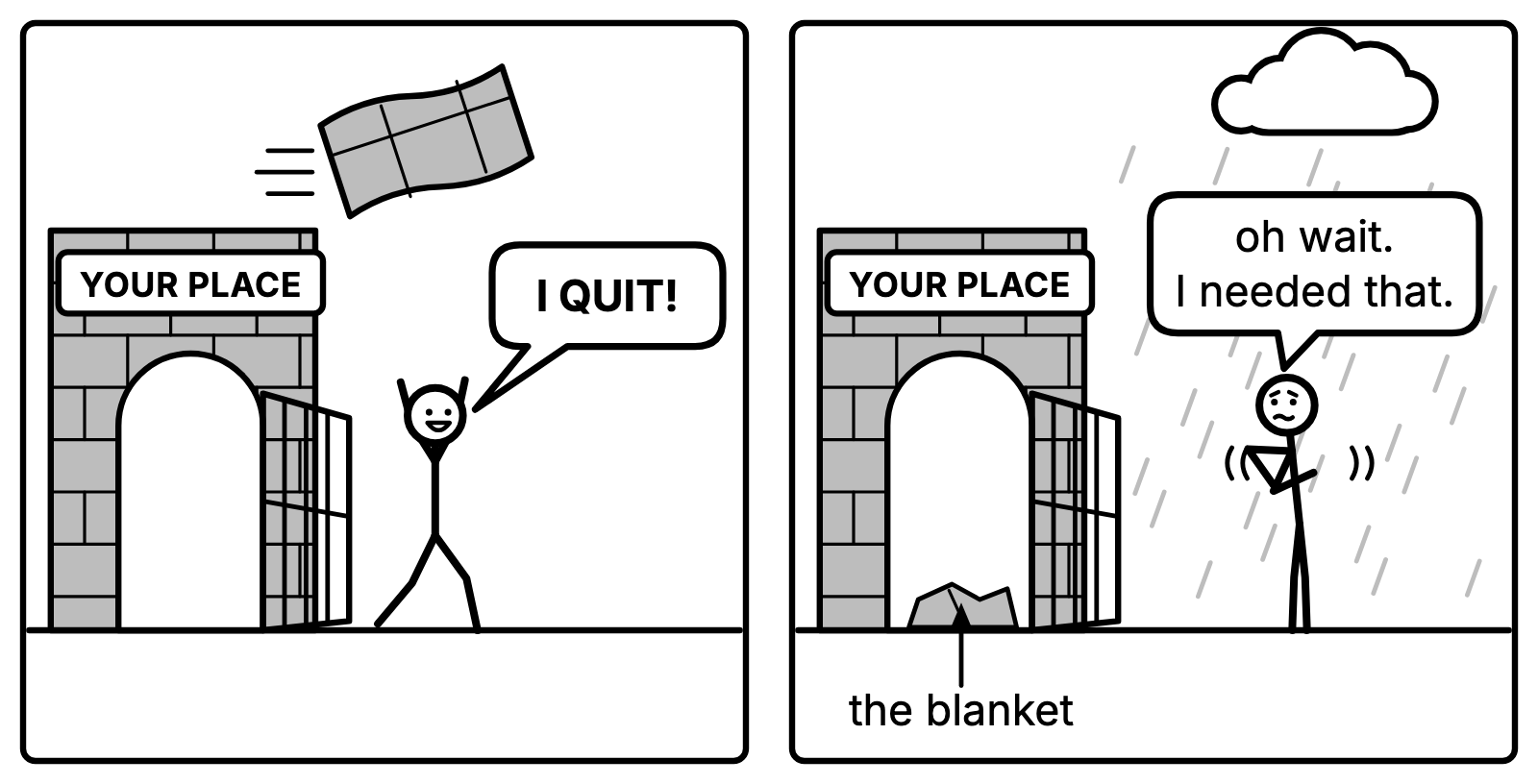
What the modern world’s brochure forgot to mention was that we were supposed to pack the blanket.
“You Can Be Anything”
We took the offer very seriously.
In the late 1970s, about a third of American high school seniors said they “definitely” expected to finish a four-year degree.
By the time Millennials were seniors, it was nearly two thirds.
Expectations doubled.
The share who actually finished on time went up too, from about a quarter to about 44%, but the gap between expecting and finishing grew from 6 points to 19.
So yeah, that’s progress.
But it’s progress the way going from a bicycle to a faster bicycle is progress when you were expecting a jet.
Part of the problem is what we look at all day.
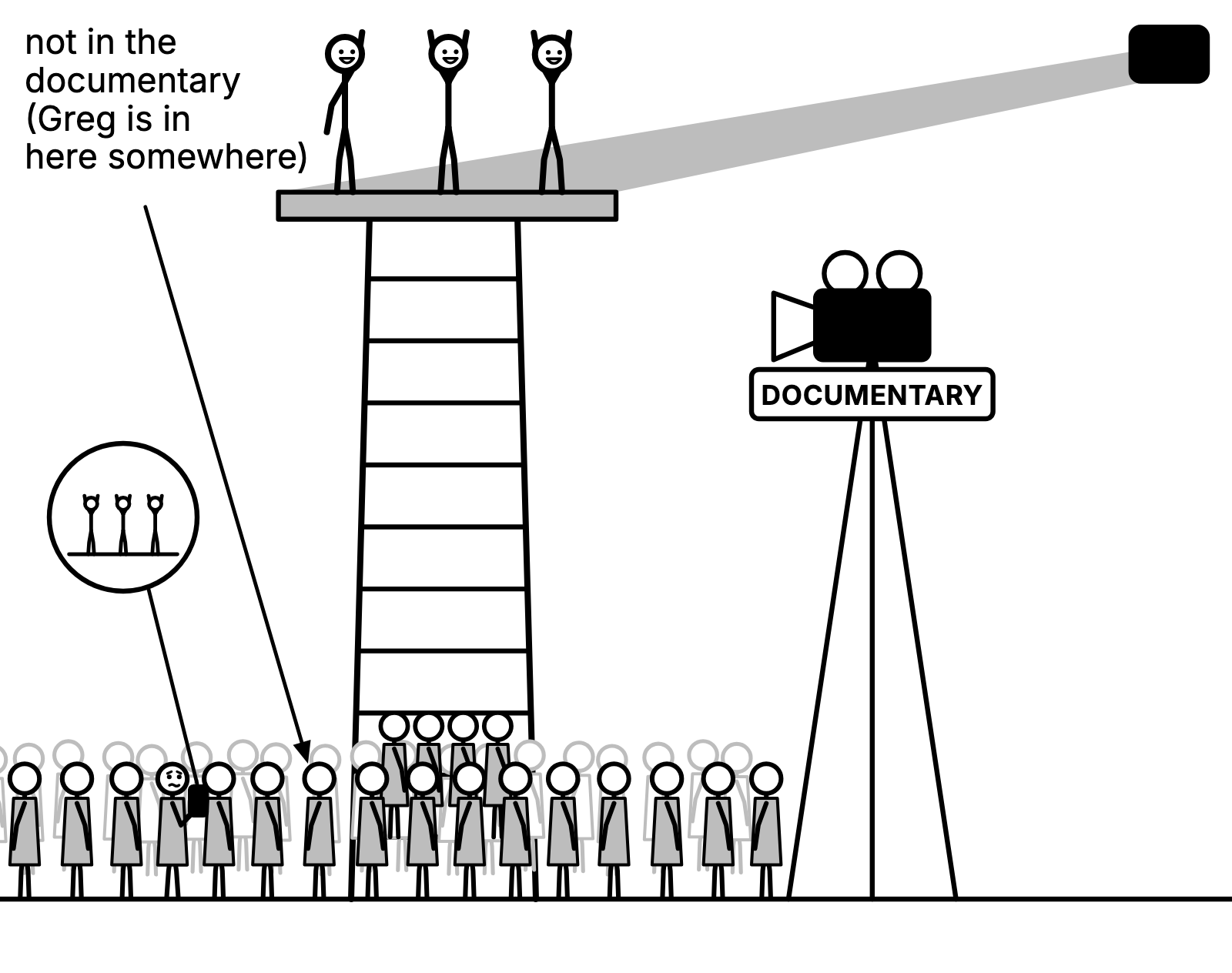
The climbers are the only people who get any media coverage.
There’s a documentary about the kid from nowhere who made the NBA, the founder who started in a garage, and the rapper who bought his mom a house.
Nobody is making a docuseries about Greg (sorry, my guy).
Greg ended up one rung above his dad.
Greg has a decent 401(k) and a solid Honda.
Greg is doing OK, thanks for asking.
Greg is a lot more common than the guy in the documentary, and you have never once seen Greg on a top podcast promoting his book.
This matters because comparison works on us whether we like it or not.
When researchers pooled 48 studies of people looking at better-off people on social media, on average, it made people feel worse about themselves.
Immediately.
Another team made it easier for University of California employees to look up their coworkers’ salaries.
The people who found out they were paid below the middle got less happy with their jobs.
Of course. Who wouldn’t?
It’s fun to be nosy until you realize you’re being paid less than your coworkers.
Nothing Was the Same
In 2013 Drake took the world by storm with his famous single, “Started from the Bottom.”
You probably know the words.
Started from the bottom now we…
Where exactly?
For Drake, “here” is a 50,000-square-foot house with an NBA-size basketball court inside it.
But “here” for the rest of us looks like, well, still pretty close to wherever we were.
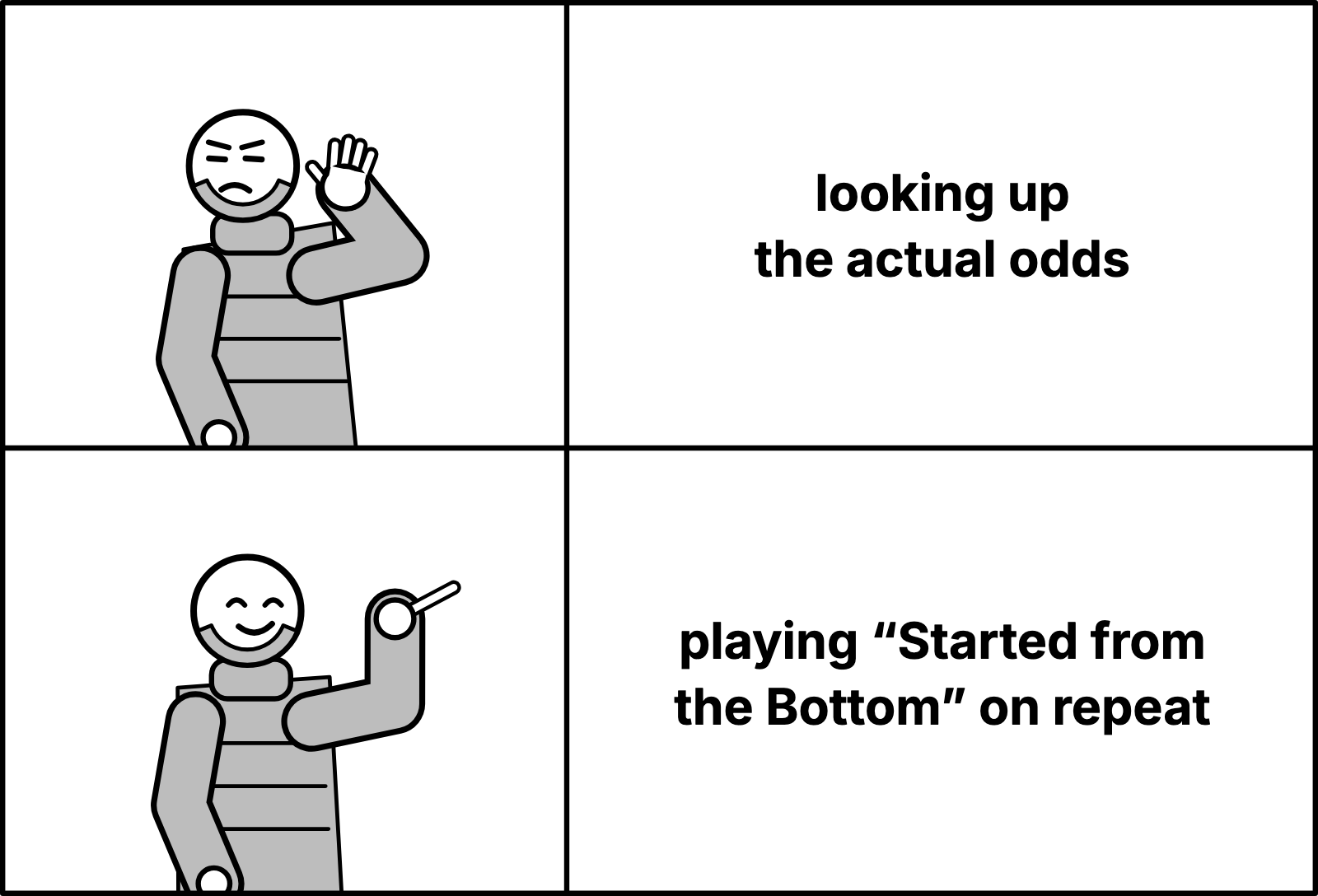
Which begs the question: how often does somebody who actually started from the bottom make it to the top?
In 2016, a team of economists asked thousands of people a simple question.
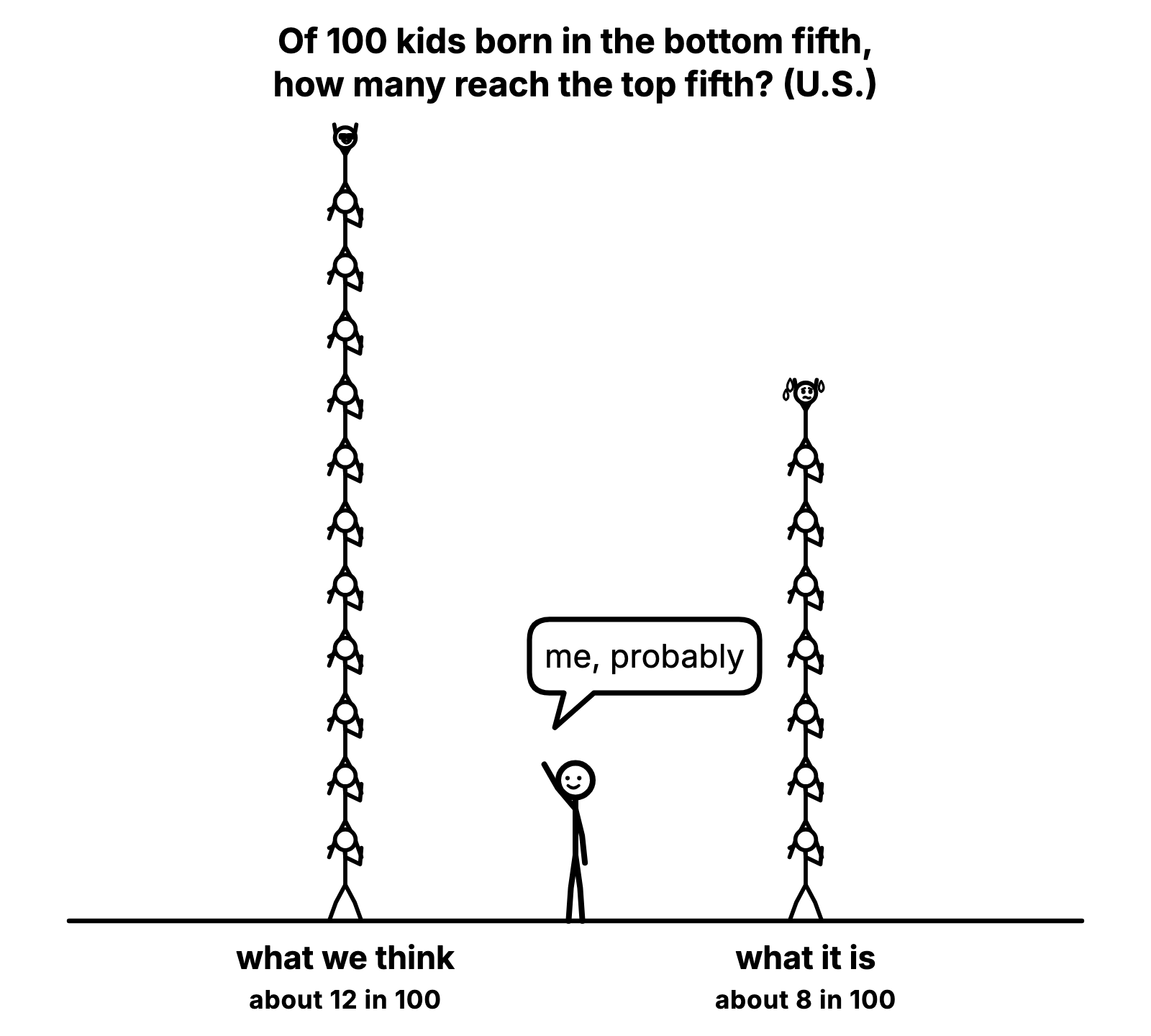
Take 100 kids born into the poorest fifth of families. How many of them end up in the richest fifth as adults?
Americans guessed about 12.
The real number, from America’s own historical data, was about 8.
That’s off by half.
If you overestimated your bank balance by half, you’d call it a problem and possibly a lawyer.
Now for my favorite part.
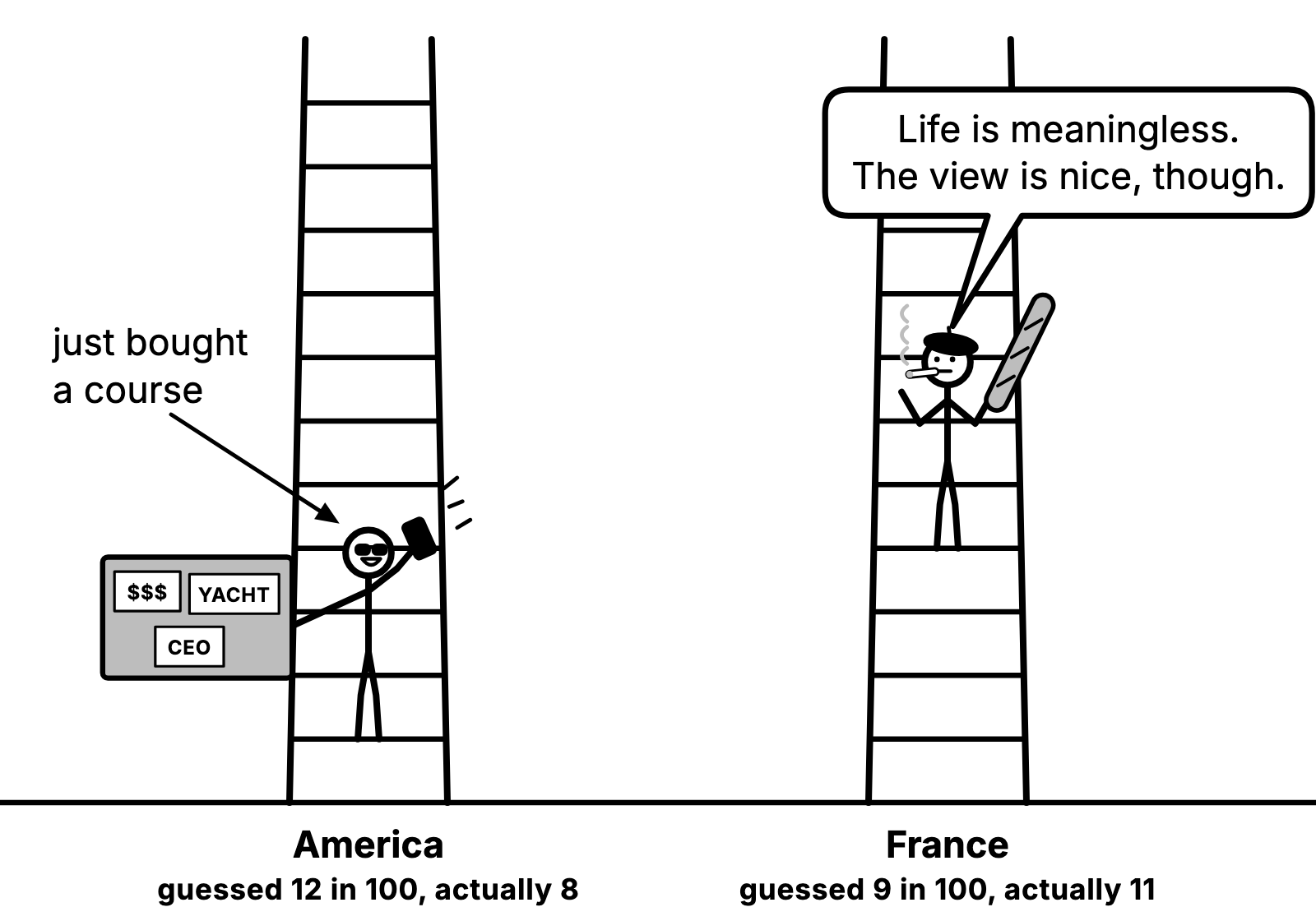
The economists asked Europeans the same question.
- The British guessed 10. The real number was 11.
- The French guessed 9. The real number was 11.
- The Swedes guessed 9. The real number was 11.
Europeans climb more than Americans yet assume they climb less.
They’re three rungs up, smoking, complaining that the whole ladder is rigged.
Americans are on the bottom rung in sunglasses, talking about maximizing their potential, and taking selfies.
The Ladder to Nowhere
This is, unfortunately, the most surprising (and crushing) news.
The odds of making the climb have barely changed in decades.
For Americans born in 1971, about 8.4% of kids from the bottom fifth made it to the top fifth by their mid-20s. For kids born in 1986, it was 9.0%.
Fifteen years of birthdays, a recession and the iPhone, and the ladder moved six-tenths of a point (your phone’s battery drops more than that while you read this paragraph).
When we crunched the General Social Survey, going back to people born in the 1930s, it told the same story.
How closely your job follows your father’s is about the same for every generation since.
Your grandfather’s ladder and your ladder have identical rungs. Yours might just be aluminum.
90210
Another thing we don’t like to admit is that where you start the climb matters.
A kid born to a poor family around San Jose had about a 13% shot at the top fifth. A poor kid who grew up around Charlotte had about 4%.
There’s a huge variance, even within the same country.
That basically means you get three times better odds, and the main difference is which airport your folks settled down closest to.
Then there’s the family business, broadly defined.
In our data, sons end up in their father’s exact job about six times as often as chance would predict.
“Six times” is hard to feel, so let’s use doctors.
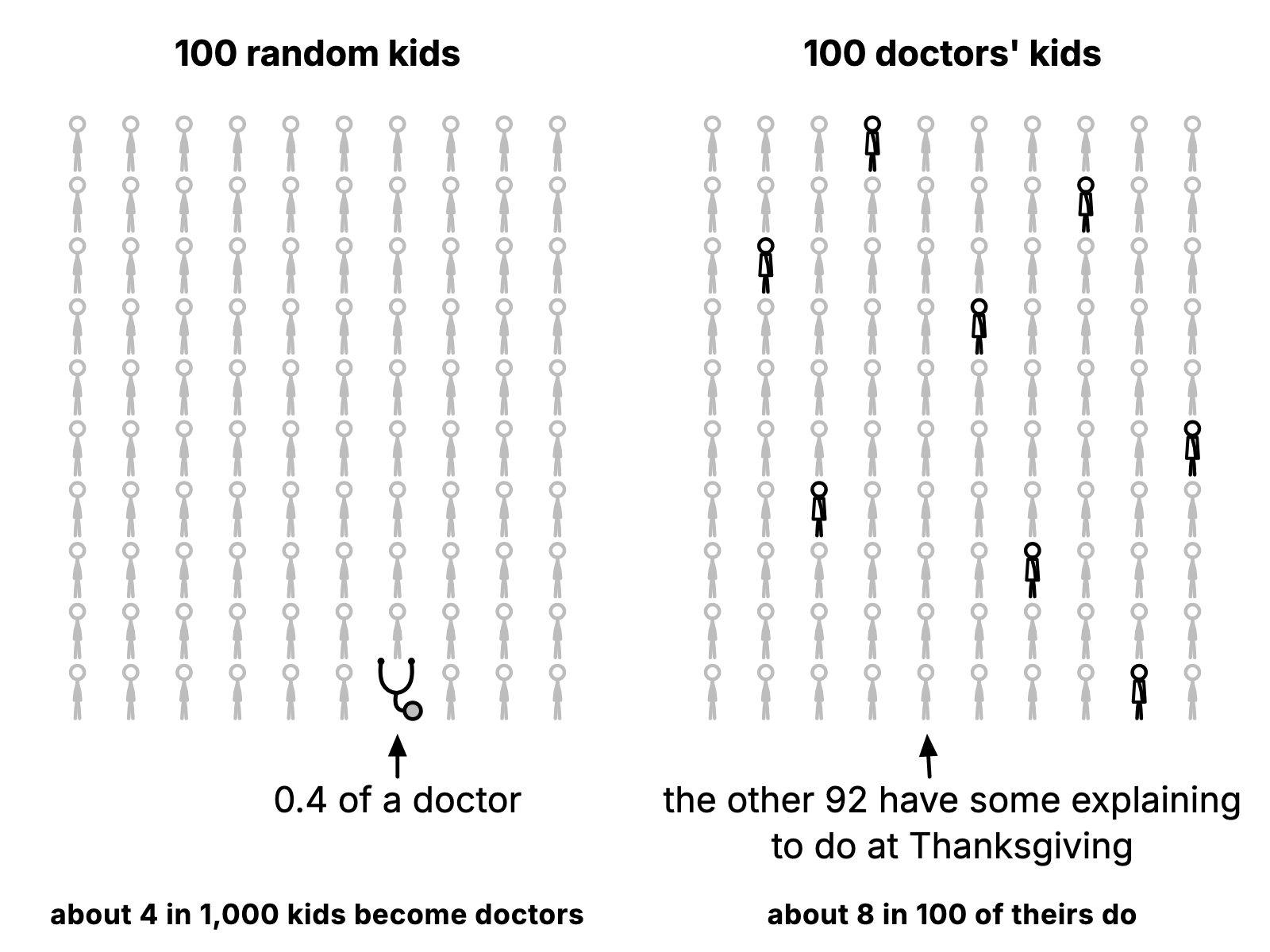
About 4 in every 1,000 kids grow up to be doctors.
But a doctor’s kid is about 21 times more likely to become one, which works out to about 8 in 100.
Put another way, a room of 100 random kids produces about 0.4 of a doctor.
That’s not a whole doctor, and frankly, they shouldn’t be operating.
But in a room of 100 doctors’ kids it produces eight.
So if becoming a doctor were a raffle, a doctor’s kid gets 21 tickets.
That’s a big head start.
And still, 92 out of 100 of them go do something else anyway.
Which is its own hero’s journey, but for another essay.
That’s the caste we can’t see.
No law makes a shoemaker’s son make shoes anymore.
There’s just a raffle where some people walk in holding twenty extra tickets.
Escalator or Stairs
There are two ways to get ahead, and we constantly mix them up.
First, we have the ladder. The common visual for moving forward in your career.
And it’s all about rank. Did you pass the people around you?
That’s the 8-in-100 number, and it’s been stuck since your grandparents’ knees gave out.
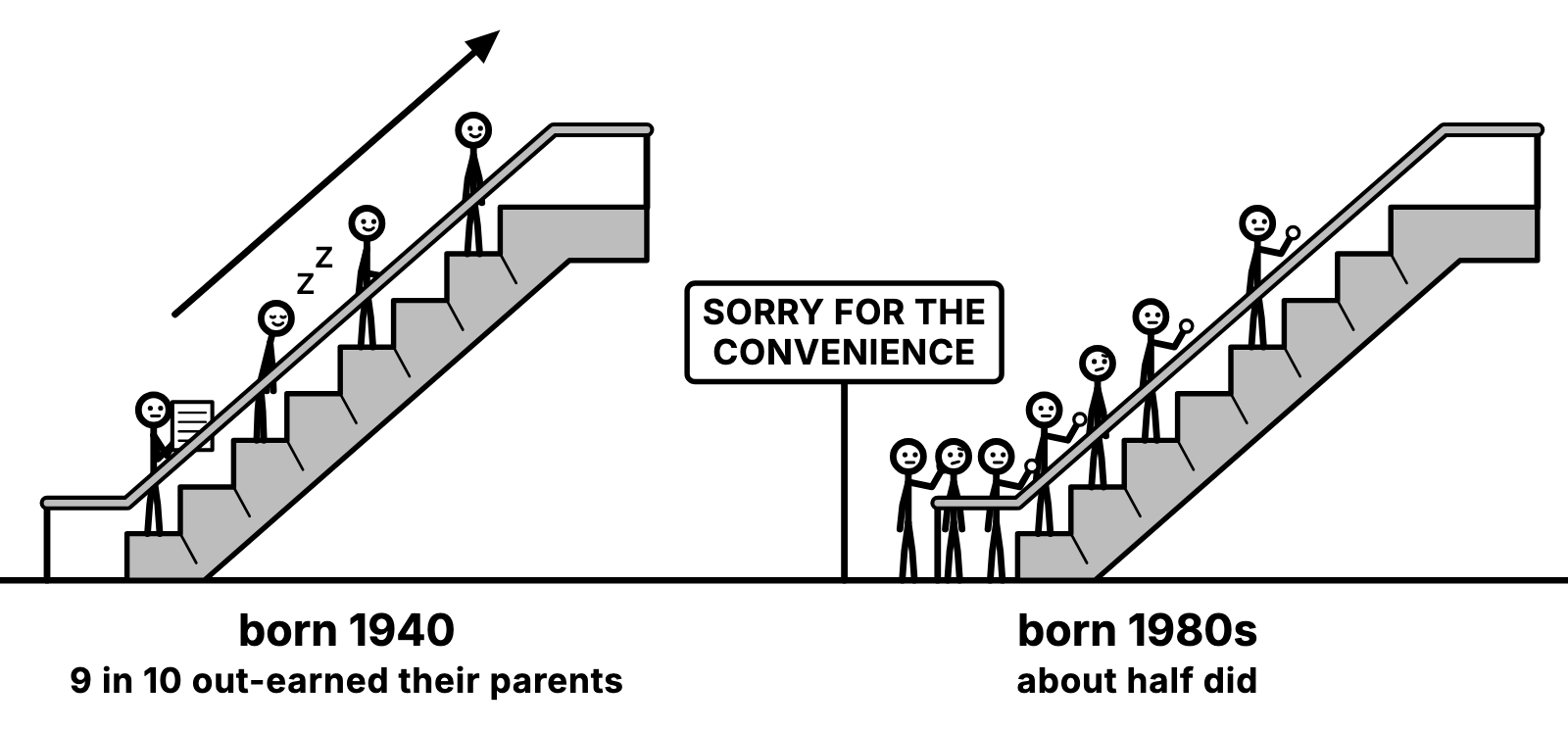
The escalator, though, is about everyone rising together.
Do you earn more than your parents did at your age?
And this contraption (hate to say) has slowed way down.
Of Americans born in 1940, about 9 in 10 out-earned their parents.
You didn’t have to be special.
You just had to stand there (pretty sweet gig).
The contraption did a lot of the work for you.
Of Americans born in the 1980s, it’s about half. A coin flip, basically. Except the coin in this scenario is your entire financial future.
The comedian Mitch Hedberg (RIP) had a line about this.
An escalator can never break, he said, it can only become stairs.
You should never see an “out of order” sign on one, just “Escalator temporarily stairs. Sorry for the convenience.”
And it’s eerily accurate to what happened with our earning potential.
The escalator broke and became stairs, but we didn’t notice.
So a lot of people are still standing on it, checking their watches, waiting for the machine to kick back on again.
We stopped moving in the physical sense, too.
In 1948, about one American in five moved house in a given year.
By 2023, it was about one in thirteen.
The country that invented the covered wagon now mostly stays put and has the wagon deliver whatever we feel like eating.
Selling the Escalator
As good Americans, we never lost our entrepreneurial spirit.
And whenever there’s a gap between what people believe and what’s legitimately true, there’s an opportunity to sell shit.
If you believe the escalator still works but you’re standing on stairs, unless you look down and notice it’s not moving, you’re going to wonder what’s wrong with you.
And that feeling can be exploited for profit. Lots of it, as it turns out.
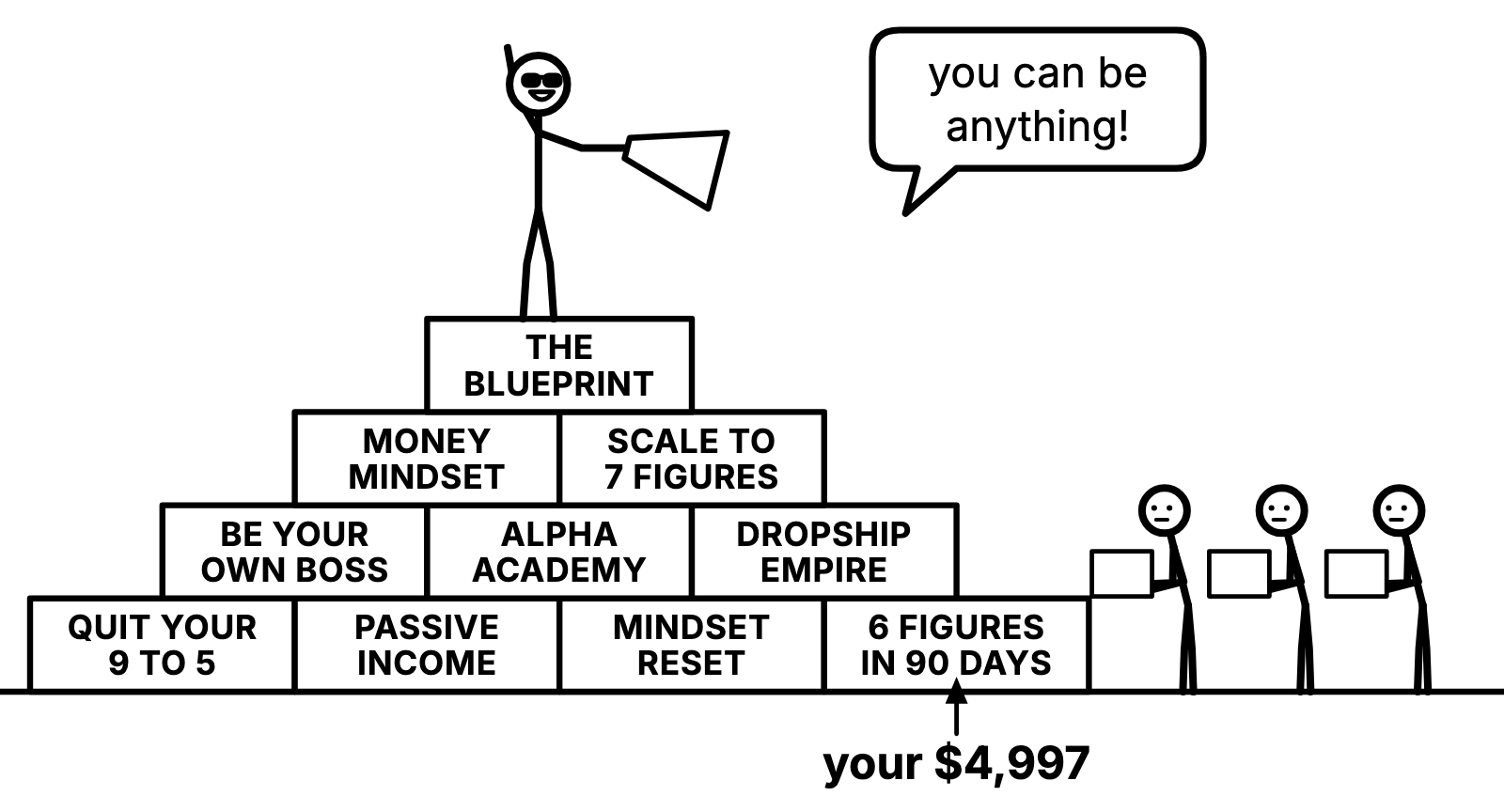
Enter the course, the program, the “passive income” system, and the trading coach who made six figures in 90 days (selling a course about making six figures trading in 90 days).
He’ll show you how for $4,997, or if you use the payment plan it’s three easy payments of $2,349.
Which is way more than $4,997, but it feels rude to do math in front of the coach, so yeah, just charge it.
The course business doesn’t have to publish its numbers. Its cousin, the MLM, sometimes does.
In 2024, the Federal Trade Commission reviewed the income disclosures of 70 multi-level marketing companies, the ones that promise you can be your own boss.
The vast majority of participants made $1,000 a year or less, often before counting what they spent.
That’s roughly what you’d make babysitting one night a month, except the baby is a garage full of essential oils who mostly just sits there and enjoys eating your savings.
You’re being sold the escalator by people standing at the top of it, and your ticket is part of how they got up there.
The Good News
Yes, there is some. The caste is real, but it’s not sealed.
First, the raffle cuts both ways.
A doctor’s kid is 21 times more likely to become a doctor, and 92 out of 100 still don’t.
Your family might stack your odds.
But ultimately, you still get to write your life.
Second, place can be changed, and it matters. Especially early.
In the 1990s, a government experiment gave some low-income families vouchers to move to better neighborhoods.
Kids who moved before age 13 earned about 31% more in their mid-20s, roughly $3,500 a year.
The younger they moved, the more it helped.
The ladder barely moves, but where you lean it matters a lot.
Third, and this is the part no one will try to sell you: knowing the real odds changes how you play.
If you think 12 in 100 make the climb and you didn’t, you assume something’s wrong with you.
If you know it’s 8, and that the escalator slowed down for a whole generation at once, you can stop blaming yourself for being stuck on the stairs.
Which frees up a surprising amount of energy that’s right now probably going to shame and trying to find more $4,997 courses.
Relative Bottoms
By his own account, Drake did start near the bottom.
His parents split when he was young, and his mom went deep into debt raising him.
“We were very poor, like broke,” he said later.
She rented the lower half of a house, and he slept in the basement.
So he really did start from the bottom. Of a house. In Forest Hill.
For context, Forest Hill is the kind of neighborhood where even the basements are in a good school district.
Around 2000, about 1 in 4 households in Forest Hill North and 4 in 10 in Forest Hill South made C$100,000 or more.
Around Weston, where he spent his early years, it was about 1 in 10.
That part was on purpose.
His mom was willing to live “far beyond her means” for her family, he said, and he moved there in sixth grade.
And remember, in the moving study, the younger the kid, the bigger the payoff.
In eighth grade, a classmate’s dad turned out to be an agent.
He helped get Drake an audition, and by 15 Drake was on Degrassi.
The song obviously skips this part, possibly because nothing rhymes well with “my friend’s dad knew a guy.”
On “Star67” Drake laments he was making 50 racks a year on TV.
In 2025, the median American with an income still made less than that (about $47,000).
So not bad for a teenager.
When critics brought up Forest Hill, Drake had an answer: “everyone has their bottom.”
He’s right. We all start somewhere.
It just helps if the bottom you start from is in a great zip code.
Back to John
John never got to choose. That was his tragedy.
Well, that and not to beat a dead horse but, again, the whole plague thing.
Our tragedy is that we were sold the dream of choice, and nobody showed us the odds.
We were told the climb is common and the escalator still runs.
Neither is quite true, and our parents’ world follows us around more than anyone wants to admit at graduation.
John knew exactly where he stood. Most of us don’t.
The least we can do is look at the real numbers before we decide what they say about us.
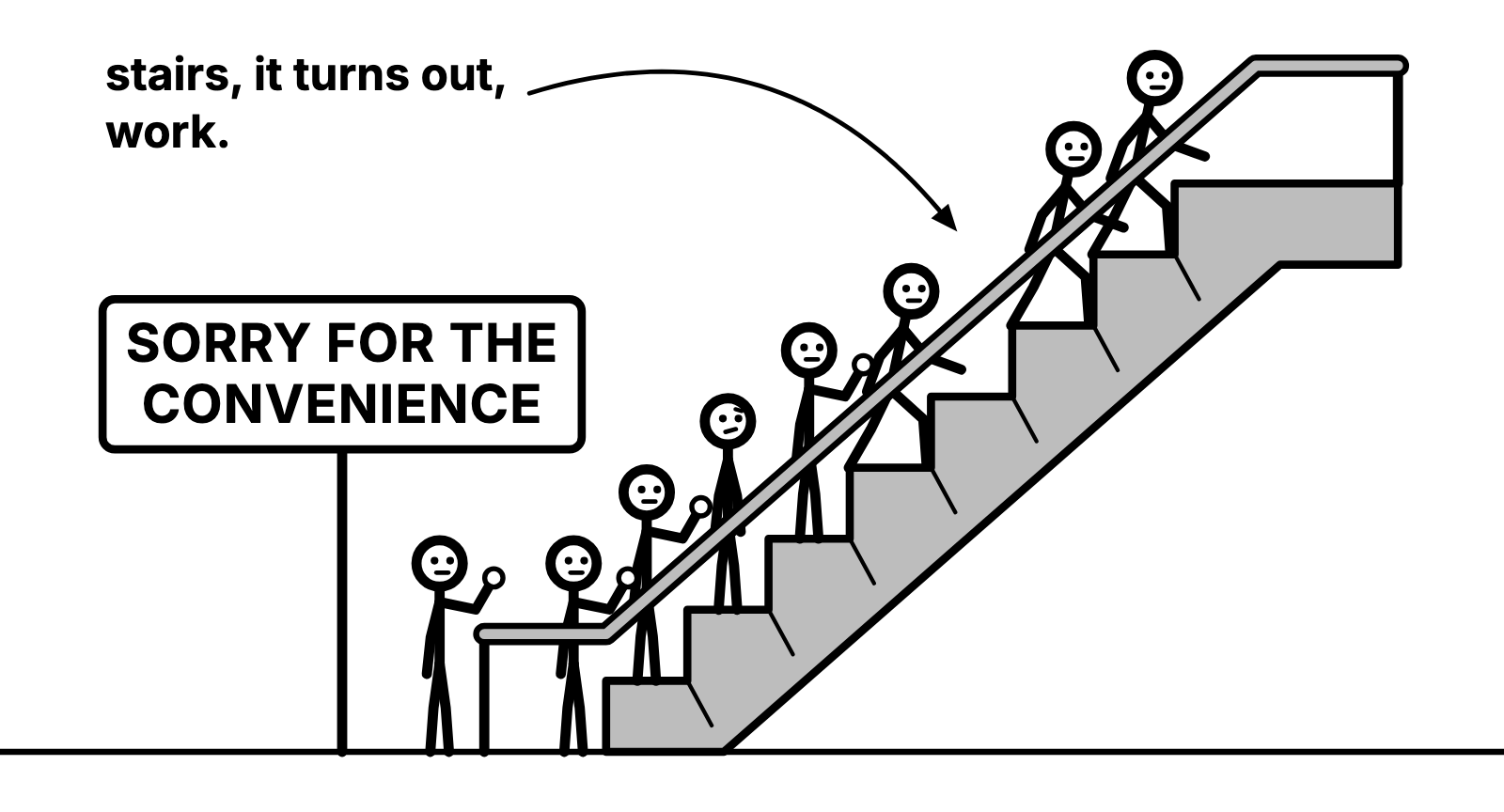
Then we have the option to take the stairs.
They’re slower than the dream we were promised, but they work, and you’ll have company.
KO
This week’s Small Brave Step: Look up your real odds.
If you grew up in the U.S., go to opportunityatlas.org and type in the address or ZIP you grew up in.
It shows how kids from that exact area turned out as adults.
Then ask yourself whether you’ve been grading your life against the bicycle or the jet.
TL;DR
- The old world locked you into your father’s job. It was a prison, and Fromm points out it was also a security blanket.
- We took the “be anything” deal and left the blanket behind. Expectations doubled. The odds barely moved.
- Americans guess 12 in 100 poor kids reach the top fifth. It’s about 8, and it’s barely moved in decades.
- The ladder is stuck and the escalator slowed from 9 in 10 kids out-earning their parents to about half. Then people sell you the escalator for $4,997.
- Drake really did start at the bottom. Of a house. In Forest Hill. Where you start shapes the climb, so know the real numbers before you decide what they say about you.
Talk soon,
Kia
Want short ideas on cultivated courage? Follow me on LinkedIn, YouTube and Instagram.