Cultivated Courage
The fix-me economy
Rooted in the work of Alfred Adler, who thought the surest way to feel like you matter was to be useful to someone else.
At some point in the last fifteen years, humanity decided to fix itself.
Between 2013 and 2019, the number of self-help titles in the United States went from 30,897 to 85,253 a year. That’s almost three times as many books about how to become a better version of you, in the time it takes a kid to get through elementary school.
To give you a sense of how many books that is, let’s say George Washington got really into personal growth. On the morning he took office in 1789, a time traveler hands him the pile of 85,253 and he starts reading one a day. If he never stops, and nobody has the heart to tell him he’s died, he’d finish the stack in about 2022.
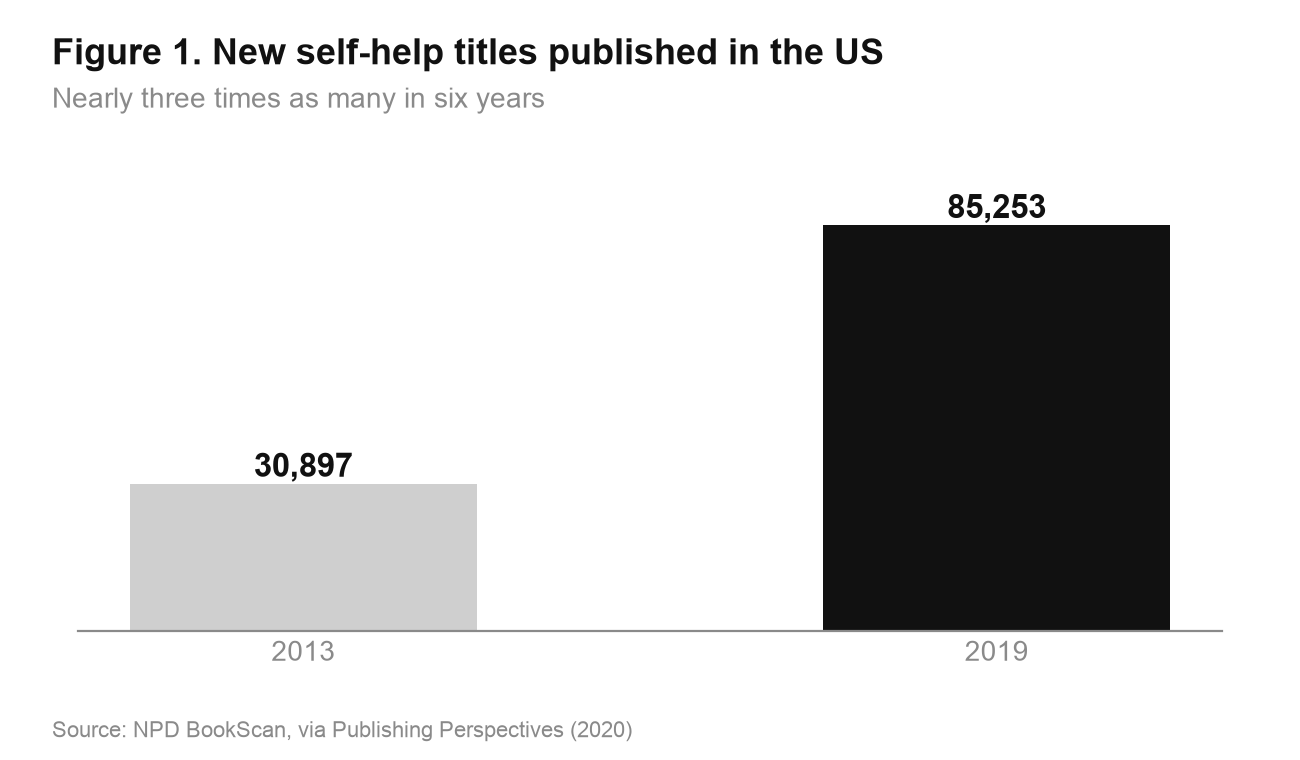
So why do we keep cranking these out?
Because people are buying them. A lot. Self-help sales in the US went from roughly 9.5 million copies in 2013 to 18.6 million in 2019.
The wider self-improvement industry (the courses, the coaches, the apps, the retreat where you’re not allowed to eat but you are allowed to pay) now pulls in something like $50 billion a year worldwide. That’s about twice NASA’s entire budget. Apparently we’d rather fix ourselves than explore the galaxy.
Call it the fix-me economy.
Meanwhile, in 2010, almost nobody in America was googling “attachment style.” Now you can’t get through a first date without someone asking about yours. (No shade, I’m guilty of this too.) “Dopamine detox” went from nothing to a craze in about four years, mostly from people who announced it online.
After all that, you’d expect us to be doing great.
So…why aren’t we?
The Scoreboard
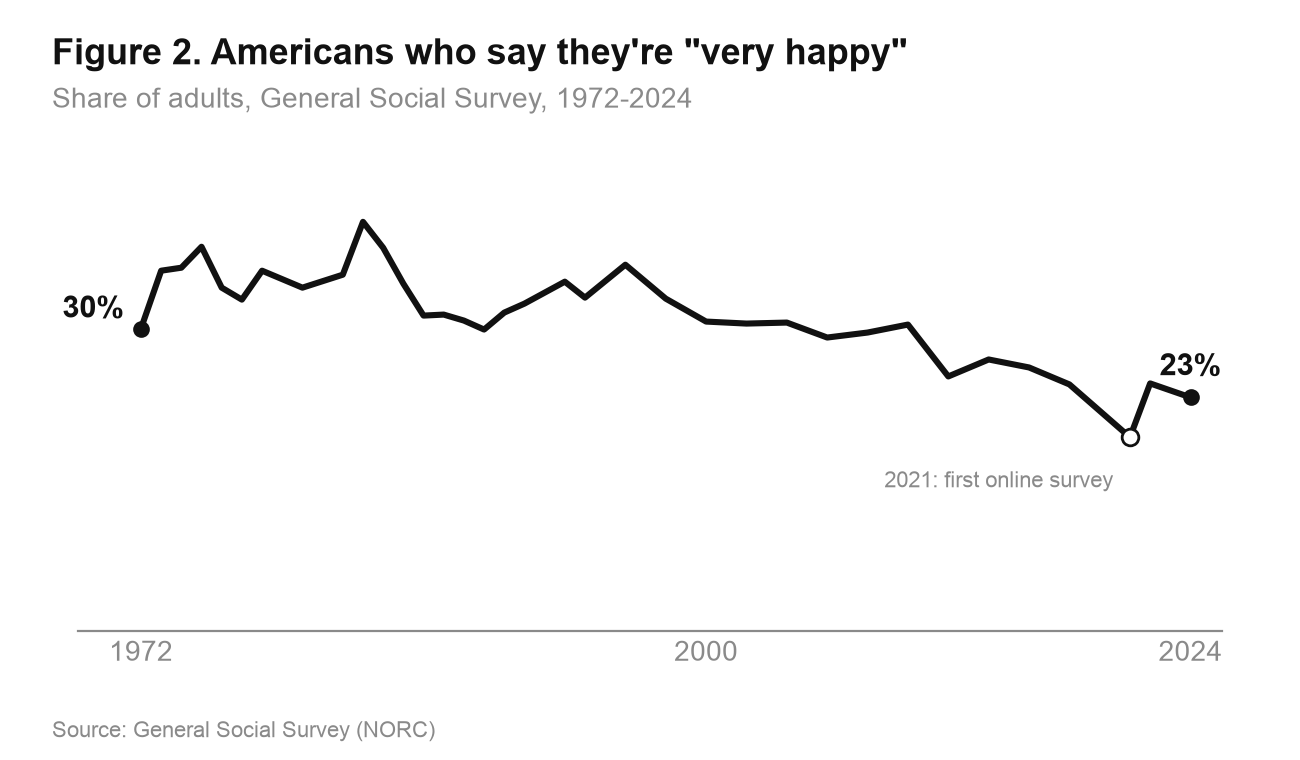
Since 1972, the General Social Survey has asked Americans a simple question: taken all together, how happy are you?
Picture a room with a hundred Americans in it, and ask everyone who’s “very happy” to raise a hand. For most of the 1970s, 80s and 90s, you’d get about a third of the room. Ask the same room in 2024, and ten of those people put their hands down.
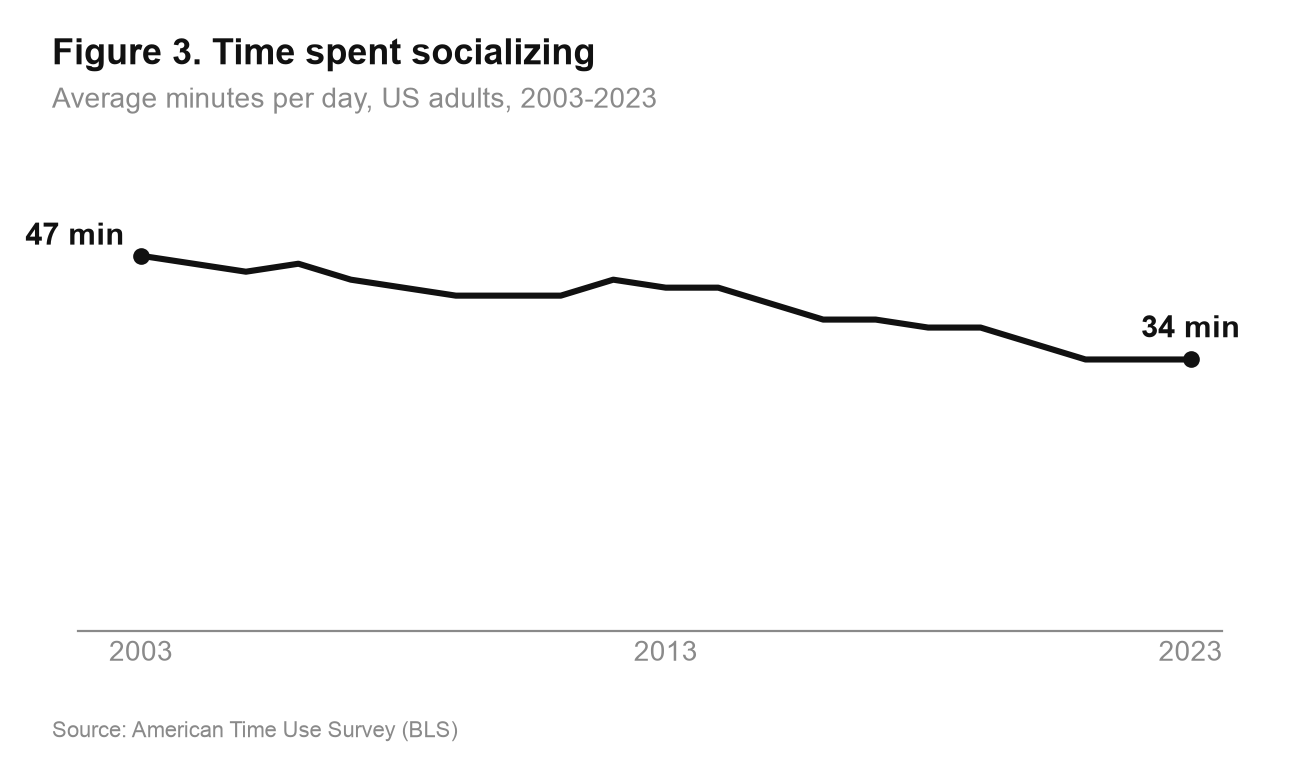
Now look at how much time we’re spending together. In 2003, the average American adult spent about 47 minutes a day socializing. By 2023 it was 34.
Thirteen minutes doesn’t sound like much. It sounds like a long shower. But it slipped away a little at a time, and over twenty years it adds up to more than a month of not being around people. That’s a whole summer at camp with all your friends, just…gone.
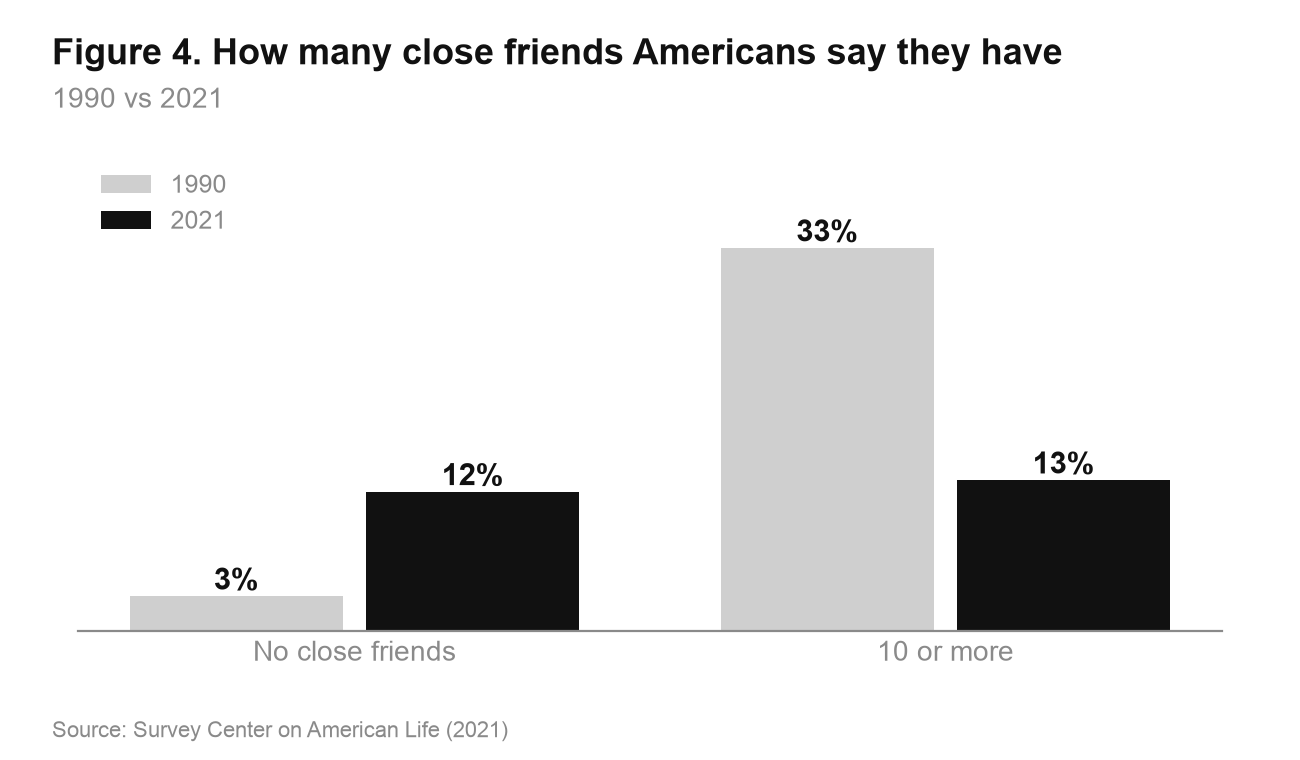
And in 1990, 33% of Americans said they had ten or more close friends. By 2021 it was 13%. The share with no close friends went up from 3% to 12%, and that nine-point jump is roughly the population of Florida, except all of them are eating dinner alone.
Now, none of this proves the self-help boom caused the slump. A lot happened in those years, including phones, a pandemic, housing costs, and all the madness surrounding AI. But it’s a weird parallel. If you hired a personal trainer and got steadily fatter for years, at some point you’d probably want to have a conversation.
Let’s see if we can figure out what’s going on.
The Emperor Gets a Dashboard
I like to imagine there’s a tiny Roman emperor who lives in your head. He sits up in the box at the Stadium of your life, eating grapes and drinking wine out of a large goblet.
He watches everything you do (with immense judgment, of course) and when you make one small mistake, he gives you a thumbs down on your entire sense of self.
For most of human history, our internal Emperors had very little data to go on, so our beliefs about ourselves were constructed mostly on our own, or influenced by those closest to us.
Between hunting dinner and fending off the neighbors, we were busy. So we spent less time self-obsessing, and nobody was keeping track of their sleep score.
Then, as life steadily improved, we had more time on our hands to put mental horsepower towards optimizing our lives.
So we built him a dashboard. We track our sleep, steps, heart rate variability, screen time, attachment style and however many micrograms of whatever GLP-1 we’re currently injecting into our abdomen. We wake up and look at our grades before we’ve had coffee.
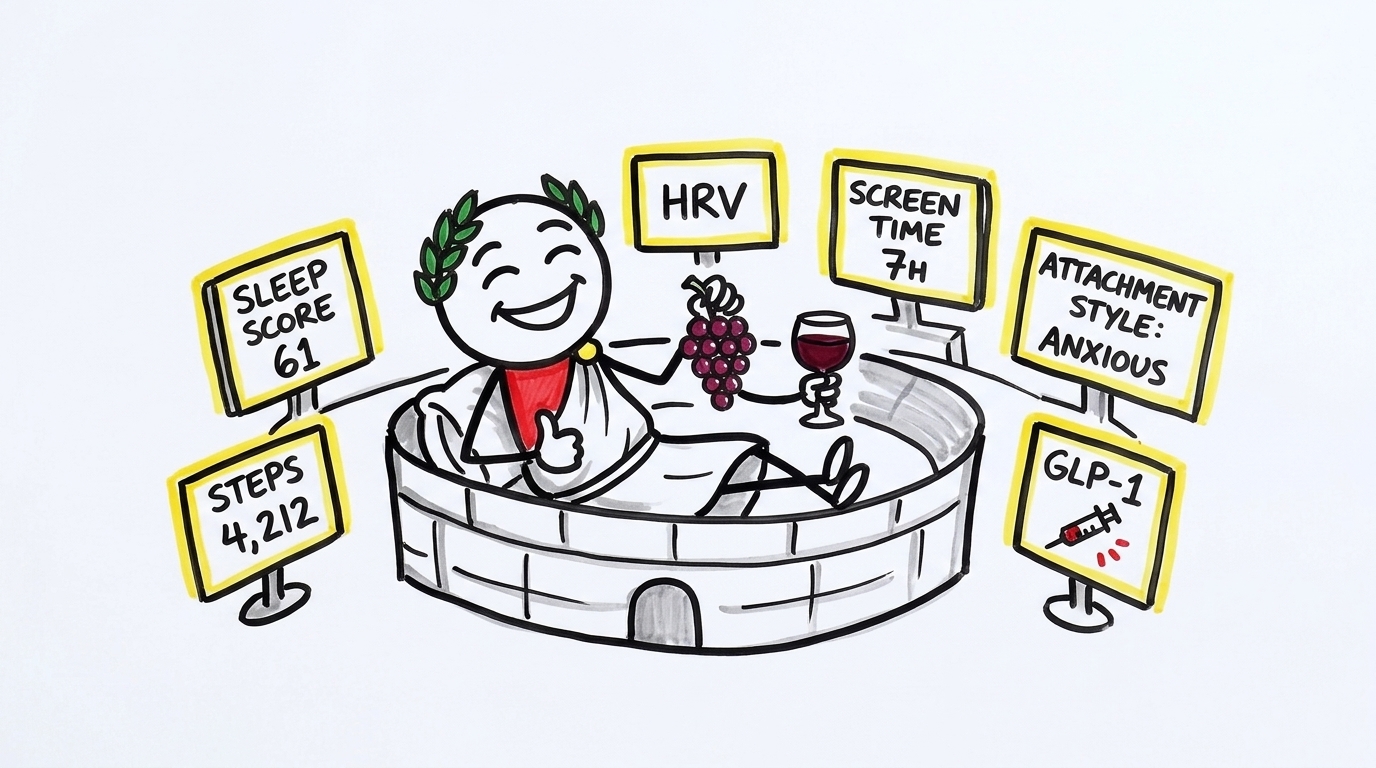
Every morning the Emperor gets a fresh scouting report on his favorite gladiator, and every report says the same thing: room for improvement.
Which would be fine if staring at yourself actually helped. In 2002, two psychologists, Nilly Mor and Jennifer Winquist, gathered up 226 research results on what they called self-focused attention, aka the habit of monitoring your feelings, your flaws, and how you’re coming across.
The finding was consistent. The more people focused on themselves, the more depression, anxiety and bad mood they tended to report.
And the worst kind was rumination. You know, the kind where you go over the same problem again and again at 2 a.m. while telling yourself you’re “doing the work.”
Then in 2011, a team led by Iris Mauss found something even stranger. People who valued happiness most highly could end up feeling more disappointed, especially in good moments, when they had every reason to be happy.
Picture your birthday party. There’s a cake with your name on it, everyone you love is in the room, and the Emperor leans over and says, “Is this it? On a scale of one to ten, would you say we’re happy right now?”
We put so much pressure on the moments we believe are supposed to make us happiest that it (ironically) often strips them of the enjoyment we were promised.
A Strange Prescription
About ninety years before any of this, a doctor in Vienna named Alfred Adler was treating people who were deeply miserable, and he’d noticed that most of them had spent years thinking about their misery with tremendous dedication. So he started giving them an odd prescription.
“You can be cured in fourteen days if you follow this prescription,” he’d say. “Try to think every day how you can please someone.”
(Yes, this is from the 1930s, and depression has better treatments now. But stay with me, because there are still some gems here.)
Adler wrote down what his patients said back, and they were not having it.
Some said, “This will be very easy for me. I have done it all my life.”
Adler’s comment, in full: “They have never done it.”
Some of them said, “Why should I please others? Others do not try to please me.”
To which Adler, a licensed physician, replied: “You must think of your health. The others will suffer later on.”
Basically he’d told the insomniacs that they could use all the time they spent lying awake to think about how to please someone. The next day he’d ask if they’d done it, and they’d say, “Last night I went to sleep as soon as I got into bed.”
Adler’s cure for insomnia, in other words, was the threat of having to think about other people.
Two Arrows
Adler’s whole psychology comes down to a pretty simple picture.
Everybody, he said, starts life feeling like they’re not enough. You begin as a very small person surrounded by giants, and that feeling never fully leaves.
Potentially one of his most flammable yet powerful beliefs was that this feeling wasn’t a problem. That never-enoughness you feel deep in your soul? Yeah, he actually thought that was fine. He called that feeling a “stimulant,” or the push that moves us toward our goals.
What mattered more than having the feeling was what you did with it.
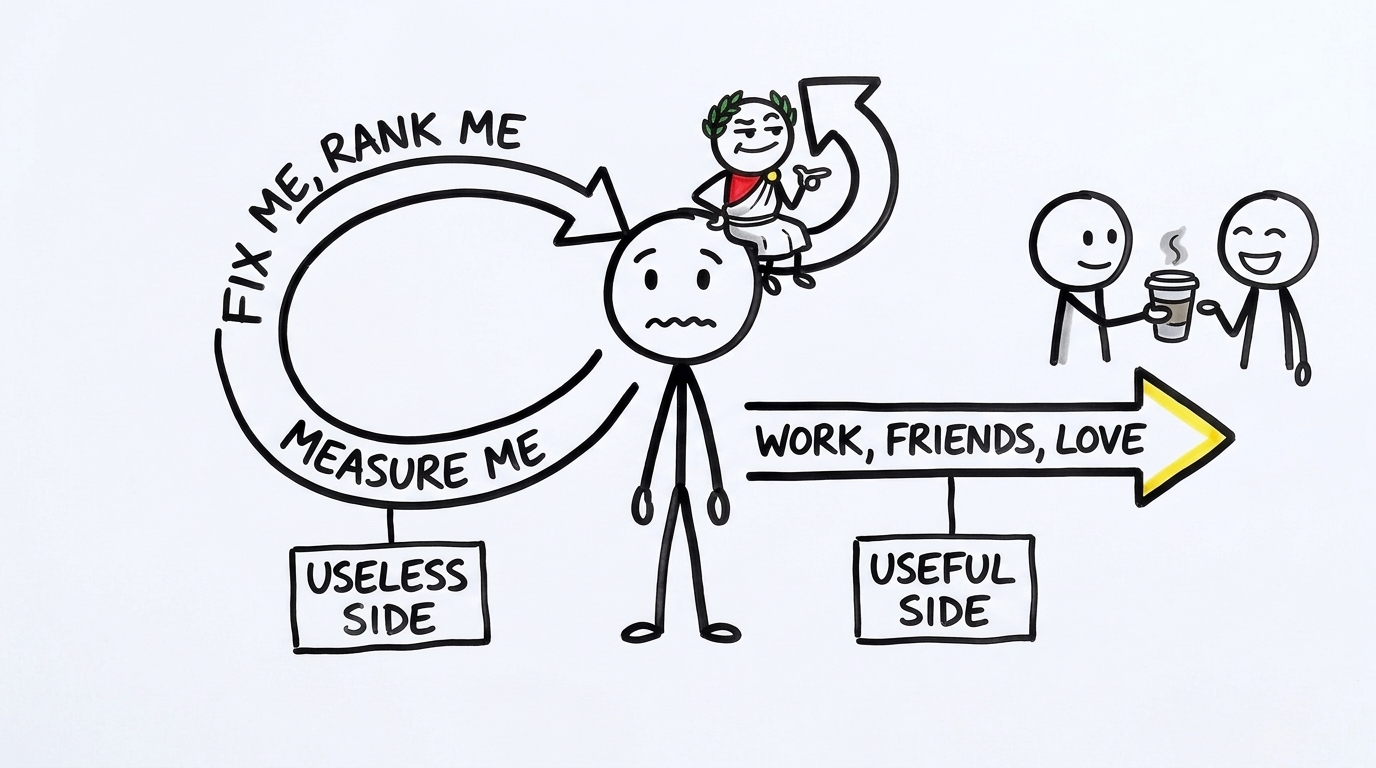
Adler separated this motion into two directions.
One arrow, the one that curls back and points at you, he called the useless side of life. The other, the arrow pointing outward towards others, he called the useful side. And he thought it was the only reliable way to feel like you matter.
His word for that was Gemeinschaftsgefühl, usually translated as “social interest” (also a good way to win at Scrabble if the rules are extremely lenient and allow German).
Self-improvement can go on either arrow, which is what makes the distinction so difficult to nail down.
Building a company that solves a real problem points outward. Building the same company so your ex sees you in Forbes curls straight back to please the internal Emperor. It can be the exact same company with completely different outcomes.
The curly arrow has always existed. The modern fix-me economy just packaged it up and made it a one-click upsell.
Before You Throw Out Your Books
I’d like to point out that you’re reading an essay that would technically qualify as self-help, which I realize makes me complicit in my own argument.
So I want to be clear: personal development books have changed my life. I’m not saying self-examination is bad. Have you ever met someone who has zero self-awareness? Yeah, they’re usually not a great hang. The genre should exist.
But a few things are worth keeping in mind.
The hardest part of self-improvement is noticing when it’s become a hiding place. A morning routine can be preparation for a life, or it can be a very well-organized way of not having one.
Ask what the improvement is for. If the answer involves another person, a piece of work, or something you’ll actually go do, it’s probably pointing out. If the answer is “to finally feel ready,” the Emperor has been reading your stats again.
Self-focus has no finish line. There’s always another flaw, and a new one will be trending by next week. It’s the old trap of the goalpost that keeps moving, except this time the goalpost is you, and your enlightenment. What’s more enticing than that?
The fastest relief usually comes from someone else. In 2008, Elizabeth Dunn, Lara Aknin and Michael Norton gave people $5 or $20 and told them to spend it by that evening, either on themselves or on someone else. The people who spent it on others were happier that night, and the amount didn’t matter. (It was a small study, though, so hold it loosely.)
And then there’s the one that you’ve probably heard about. The Harvard Study of Adult Development (which has been following people since 1938) found that how satisfied people were with their relationships at 50 predicted their health at 80 better than their cholesterol did.
So yeah, being kind, keeping your friends close, and helping others is probably a good general principle to live by.
Quick question: your doctor checks your blood every year. When was the last time you looked at the health of your friendships?
Fourteen Days
Try the experiment. For the next two weeks, think every day about how you could make someone else’s day better. Then go do it.
This doesn’t have to be a gargantuan task. Call the friend. Tell them what they’ve meant to you. Buy the coffee for the stranger behind you.
Tell your partner you love them (and not in the perfunctory way when you’re walking out the door for work). Put some oomph behind it and say it like you mean it. See what happens.
Now, you might be thinking what Adler’s patients thought: that others don’t try to please you, so why go out of your way for them? And you’re probably right. They probably don’t (too busy looking at their calorie counter, I’d wager).
Or maybe you feel that this will be very easy for you.
Because of course, you’ve been doing it all your life.
In which case, I’d gently bring us back to Adler’s verdict:
“They have never done it.”
This week’s Small Brave Step: Run Adler’s experiment for fourteen days.
Each day, do one thing to make someone else’s day better, and notice how you feel after.
TL;DR
- Between 2013 and 2019, self-help titles in the US nearly tripled. Over the past few decades, we got less happy, spent less time with each other and lost close friends.
- We built the Emperor in our heads a dashboard: sleep scores, step counts, screen time, attachment styles. The more people focus on themselves, the worse they tend to feel (Mor and Winquist, 2002).
- Adler’s prescription for his most miserable patients: “Try to think every day how you can please someone.”
- His picture of the mind has two arrows. One curls back at you (fix me, rank me, measure me). The other points out at the world, and he thought it was the only reliable way to feel like you matter.
- Self-improvement can go on either arrow. Ask what it’s for.
Talk soon,
Kia
Want short ideas on cultivated courage? Follow me on LinkedIn, YouTube and Instagram.